A unified view of graph traversal: BFS, Dijkstra, A* are the same algorithm
BFS, Dijkstra, and A* differ by one line: the data structure you pop the next node from. A worked maze example that converts each into the next.
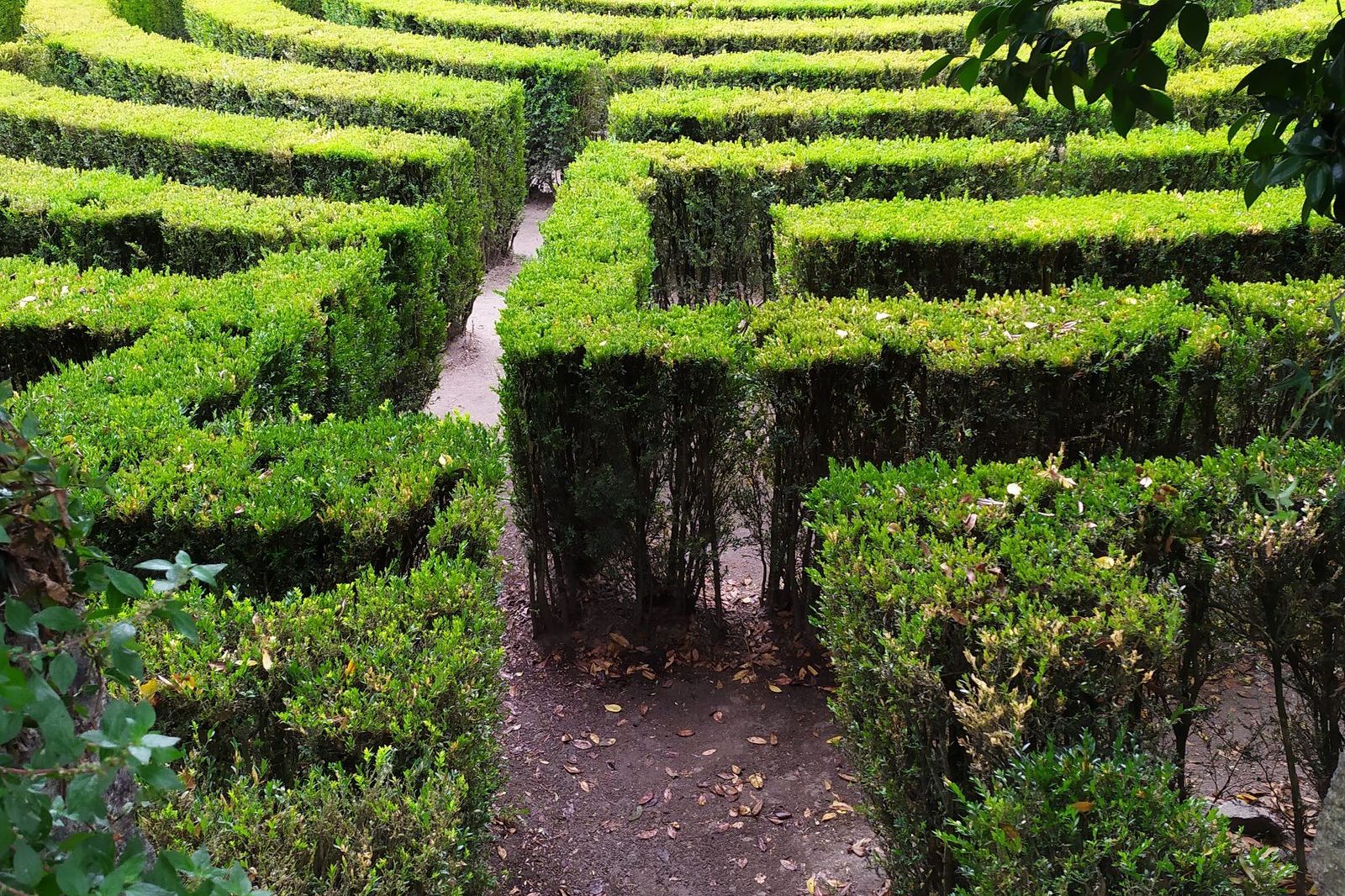
Breadth-first search, Dijkstra, and A* are usually introduced as three different algorithms on three different slides. They are not. They are the same algorithm with three different priority functions, and you can convert one into the next by editing a single line.
The clearest way I know to see this is to solve a maze.
The setup
We have a grid where 0 is a wall, 1 is a corridor, 2 is the start and
3 is the goal:
0 0 0 0 3 0 0 0 0
0 1 1 0 1 0 1 1 0
0 1 1 0 1 1 1 1 0
0 0 1 0 0 1 0 0 0
0 1 2 1 1 1 1 1 0
0 0 0 0 0 0 0 0 0
We want to know if there is a path from 2 to 3. The structure of every
solution will be the same:
- Keep a container of “places I still need to visit”.
- Pop one out.
- If it is the goal, win.
- Otherwise, push its unvisited neighbours back in.
The only thing that changes between the algorithms is which element we pop.
BFS — pop the oldest
A FIFO queue gives us BFS. We visit nodes in the order they were discovered, so the first time we reach the goal we have reached it in the fewest hops.
def has_path(grid, start):
    rows, cols = len(grid), len(grid[0])
    queue = [start]
    visited = set()
    while queue:
        r, c = queue.pop(0)          # FIFO — oldest first
        if (r, c) in visited:
            continue
        visited.add((r, c))
        if grid[r][c] == 3:
            return True
        for dr, dc in [(-1, 0), (1, 0), (0, -1), (0, 1)]:
            nr, nc = r + dr, c + dc
            if 0 <= nr < rows and 0 <= nc < cols and grid[nr][nc] > 0:
                queue.append((nr, nc))
    return False
For an unweighted grid, the first visit to any node reaches it in the fewest steps — which is why BFS doubles as a shortest-path algorithm when every edge has cost 1.
Dijkstra — pop the cheapest
Now suppose each cell has a cost — some corridors are gravel, some are mud, some are water. BFS no longer works: the first time we reach a node may not be the cheapest way to reach it.
The fix is one line. Replace the FIFO queue with a min-heap keyed by the total cost to reach each node. Everything else stays the same.
import heapq

def shortest_cost(grid, start):
    rows, cols = len(grid), len(grid[0])
    heap = [(0, start)]              # (cost_so_far, node)
    best = {start: 0}
    while heap:
        cost, (r, c) = heapq.heappop(heap)   # cheapest first
        if grid[r][c] == 3:
            return cost
        for dr, dc in [(-1, 0), (1, 0), (0, -1), (0, 1)]:
            nr, nc = r + dr, c + dc
            if 0 <= nr < rows and 0 <= nc < cols and grid[nr][nc] > 0:
                new_cost = cost + grid[nr][nc]
                if new_cost < best.get((nr, nc), float('inf')):
                    best[(nr, nc)] = new_cost
                    heapq.heappush(heap, (new_cost, (nr, nc)))
    return None
That is Dijkstra. A FIFO queue is a min-heap keyed by insertion order; swapping it for a heap keyed by cost gives you shortest-path for weighted graphs, for free.
A* — pop the cheapest plus a guess
Dijkstra explores uniformly outwards from the start. If we know where the goal is, we can do better by preferring nodes that look closer to the goal. That is A*.
One line again. Change the heap key from cost_so_far to
cost_so_far + heuristic(node, goal):
def manhattan(a, b):
    return abs(a[0] - b[0]) + abs(a[1] - b[1])

def astar(grid, start, goal):
    rows, cols = len(grid), len(grid[0])
    heap = [(manhattan(start, goal), 0, start)]   # (f, g, node)
    best = {start: 0}
    while heap:
        _, g, (r, c) = heapq.heappop(heap)
        if (r, c) == goal:
            return g
        for dr, dc in [(-1, 0), (1, 0), (0, -1), (0, 1)]:
            nr, nc = r + dr, c + dc
            if 0 <= nr < rows and 0 <= nc < cols and grid[nr][nc] > 0:
                new_g = g + grid[nr][nc]
                if new_g < best.get((nr, nc), float('inf')):
                    best[(nr, nc)] = new_g
                    f = new_g + manhattan((nr, nc), goal)
                    heapq.heappush(heap, (f, new_g, (nr, nc)))
    return None
If the heuristic is 0 everywhere, A* collapses back to Dijkstra. If every
edge weight is 1 and the heuristic is 0, Dijkstra collapses back to
BFS. They really are one algorithm:
| Algorithm | Priority on pop |
|---|---|
| BFS | insertion order |
| Dijkstra | cost_so_far |
| A* | cost_so_far + heuristic |
Why this is worth internalising
The list of algorithms you are supposed to know grows every year. The list of ideas is much shorter. Graph traversal is one idea with a parameter (what goes in the priority) and three famous settings of that parameter. Viterbi on a trellis is another setting. Best-first beam search in an NLP decoder is another. Dynamic programming on a DAG is another.
Once you see the skeleton, each new algorithm is a ten-minute read instead of a lecture.
This is an old note I wrote in 2019 and never published. Reposting it here because it is the kind of thing I want this blog to be: small ideas that collapse a pile of named things into one.