The pyramid principle for writing clearly
Barbara Minto's pyramid: put the answer at the top, let the reader's questions drive the hierarchy, and choose deduction or induction at each branch.
I first came across the pyramid principle in Barbara Minto’s book years ago, and keep coming back to it every time a piece of writing feels stuck. It’s the single most useful structural trick I know, and it’s aged better than almost anything else in my notes.
Most unclear writing isn’t unclear at the sentence level. It’s unclear at the structure level — the reader can parse every sentence but still has no idea what the point is, which is the part that matters, or why they should keep reading. The pyramid principle is Barbara Minto’s fix for that, and it’s surprisingly mechanical once you see it.
The one rule
Put the answer at the top. Then let the questions your reader will naturally ask drive the hierarchy beneath it.
A good document has the shape of a pyramid:
- At the apex is a single idea — the answer to the question your piece is really asking.
- Each level below is a group of supporting points that together answer a specific question raised by the level above.
- Leaves at the bottom are the evidence and examples.
The reader walks down the pyramid. You build it up.
How to build it
Start with the idea you want to land. State it as a sentence. Then interrogate it with the six questions readers silently ask:
- So what?
- Why?
- How?
- Where does this apply?
- When does this apply?
- Who should care?
Group the answers. At each branch you make one structural choice:
- Deductive — “Birds fly. I am a bird. Therefore I fly.” Good when the argument is a chain and each step depends on the previous one.
- Inductive — “Birds fly for three reasons: they have wings, they are lightweight, they are aerodynamic.” Good when you have parallel evidence for a single claim.
Deductive chains are rigorous but brittle — break a link, lose the reader. Inductive groupings are robust but only as strong as their weakest parallel point. Pick per branch, not per document.
The three-second test
A pyramid-structured document has a useful property: the reader can stop at any depth and still have a coherent takeaway. Read only the headings and you get the shape of the argument. Read only the top sentence of each section and you get the argument itself. Read the whole thing and you get the evidence.
This is also the fastest editing tool I know. Strip a draft down to its headings and top sentences. If that skeleton doesn’t make sense, no amount of sentence-level polishing will save the piece. If it does make sense, the rest is just fleshing it out.
Why it works
Readers read top-down and left-to-right. They carry a running model of “what is this piece arguing?” in working memory. Every sentence either confirms the model, updates it, or confuses it. The pyramid minimises the third category by front-loading the answer and signposting every branch, so the reader spends their attention on the evidence instead of reconstructing the argument.
It also forces the writer to actually have a point. If you can’t write the apex sentence, you don’t have a piece yet — you have notes.
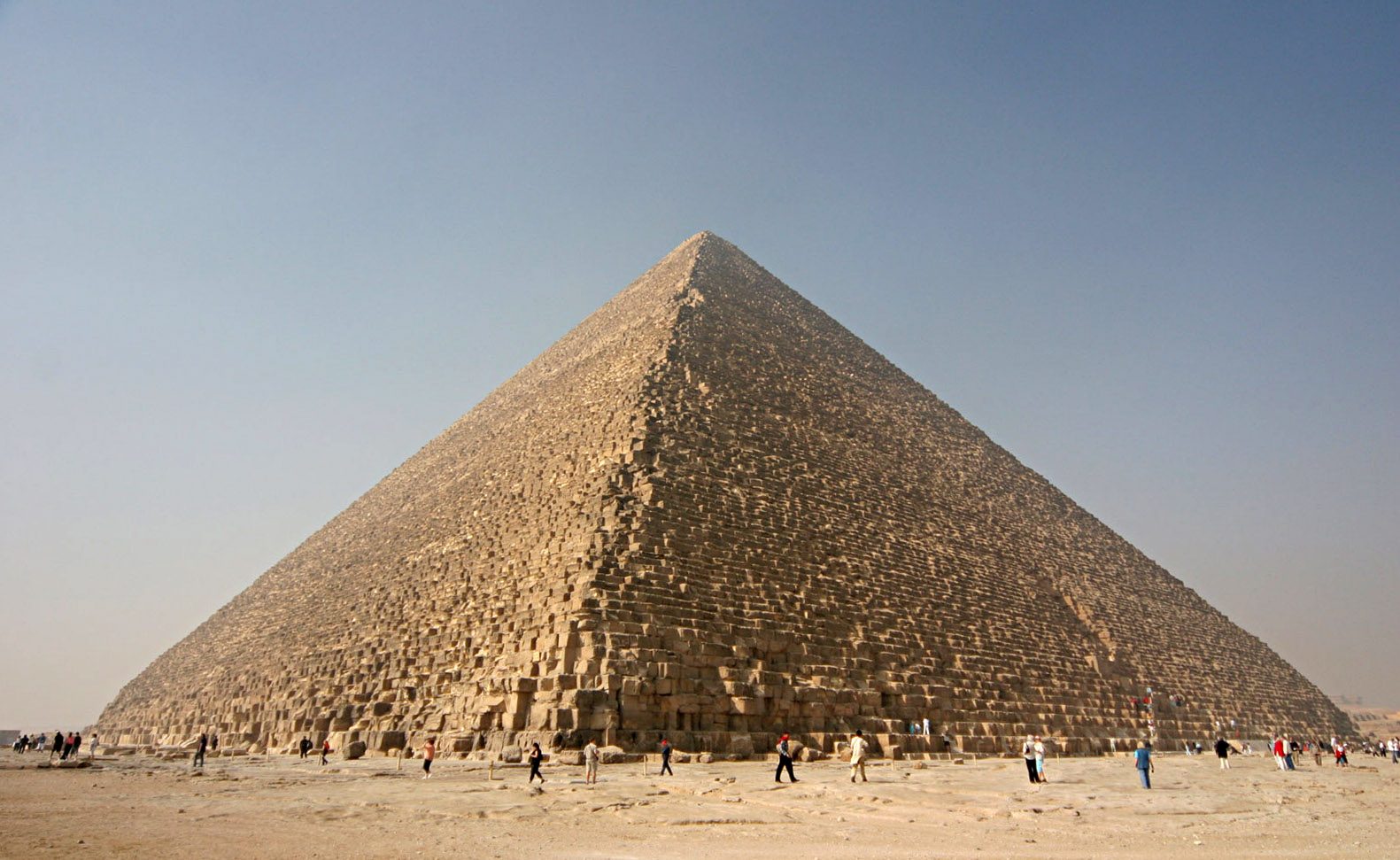
Cover: Great Pyramid of Khufu, photo by Nina (Wikimedia Commons, CC BY 2.5).